If this message is not displayed correctly click here |
Issue 786 - May 18th - 22nd 2026 - Expressly created for 3709 wine lovers,
professionals and opinion leaders from all over the world | |
|
|
| | | Carlo Petrini, one of the most influential figures in contemporary food culture and beyond, has died. The founder of Slow Food and Terra Madre passed away at the age of 76 in Bra, the city where he was born. With him, we lose one of the greatest thinkers of our time, capable of transforming the simple act of eating into a political, cultural, and poetic act. His philosophy of “good, clean, and fair” has inspired millions of people around the world to rediscover the value of time, the land, and community. Thanks to Carlo, food is no longer just nourishment; it has become consciousness, resistance, and mindful slowness. | |
|
| | Carlo Petrini was the first to realize that through food, wine, agriculture, and cooking, one could engage in politics. Real politics, with a capital “P”. “Carlin” understood, before others, that through food, wine, agriculture, and cooking, a community’s identity, its rituals, and its soul are built. Lofty, philosophical, almost “ethereal” concepts, yet always expressed in concrete terms, summed up in his famous motto, which has become a mantra for Slow Food, namely, “good, clean, and fair”. Three words that intertwine the theme of the pleasure of food, which must be a right for all; of its quality, for which a fair price must be paid, just as those who work the land and produce food must be fairly compensated. There is the theme that the value of food and wine must be assessed, not the price. There is the issue of environmental sustainability, which is fundamental, with the current food system considered the primary driver of climate change, but which must not clash with radical environmentalism. There is also the issue of a global food system that needs to be radically changed, to move “beyond consumerism and save humanity”. Food communities are the first and most powerful antidote to rural depopulation, provided that their identity is preserved and not sold (or sold off) solely to the tourism industry. There is confidence in young people and their role as leaders of a “revolution” that must be “joyfu”, because “you can’t make revolutions with a heavy heart”. So many issues that Carlo Petrini raised and brought to the attention of the public and the tables of the world’s powerful, and which, so many times, over so many years, in so many places, from his many visits to Montalcino (as early as the 1980s, ed.) to meetings in Turin or the Langhe, in the many interviews and conversations we had the pleasure of sharing, “Carlin” Petrini has addressed, with openness and never with superficiality, with WineNews. Gifting us with many words through which we wish to remember him (in depth). | |
|
| | “Thanks to him, a “pious agnostic” according to Pope Francis’s perfect definition, food is no longer just nourishment, but consciousness, resilience, and mindful slowness. He introduced me to this world and sparked my passion for it, ever since 1986, when we met in Montalcino, where I was born and where Slow Food also took its first steps”, This is the memory of Carlin Petrini shared by Alessandro Regoli, director of WineNews, which he founded with Irene Chiari, for whom “Petrini was a person of powerful feelings and values, and exemplary consistency”. And an inexhaustible source of inspiration and reflection for the entire WineNews staff, say Federico Pizzinelli and Emma Lucherini: “Without him, the world will never be the same: it must be better, starting with the food we eat and write about every day”. To his sister Chiara and to Slow Food, our warmest embrace. | |
|
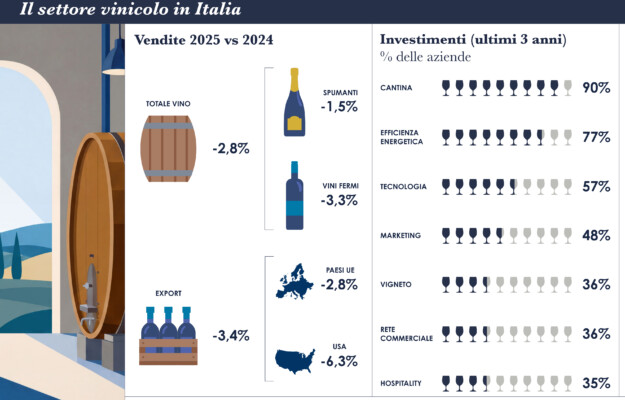
| | | The decline continues, and remains a cause for concern, with a clear slowdown compared to 2025, but with a smaller percentage-point impact than in the previous month, which at least brings a slight sense of confidence. Italian wine exports, according to Istat data analyzed by WineNews (in-depth analysis), stood at 1 billion euros in value in the cumulative figure for February 2026, down 13.3% compared to the same period in 2025. While the first “report” for January 2026 showed a -18.7% decline in value, the figure for February alone stands at -8.2%. Volumes also saw a significant jump, largely closing the gap accumulated in the previous month: a total of 158 million hectoliters in February 2026, down 3.2% compared to the first two months of 2025. This picture mirrors the data from the United States, which fell to 243.4 million euros in value during the first two months of 2026, a sharp -27.48% compared to 2025. A similar trend is seen in Germany, the top European market for Italian wine, which is approaching 162.7 million euros in exports, a 9.1% decrease compared to the same period in 2025, but an improvement over January 2026 (which was down 15.1%). Trailing behind are the United Kingdom at 93.4 million euros (-12.9%), and Canada, with 60.78 million euros in imports (-2.5%). | |
|
| | | Over the past five years, 80% of Italian producers have reported a decline in wine consumption; two-thirds expect this trend to continue in the coming years. Despite this, 70% of producers continue to view the sector as attractive, believing it is headed toward a more rigorous process of consolidation. However, 58% of major wine producers expect overall sales to grow by 2026. This is the sentiment emerging from the survey on the wine sector in Italy, conducted by the Mediobanca Research Department (in-depth analysis). | |
|
| | Italian wine, which accounts for over 50% of its exports to the U.S., Germany, and the U.K., must diversify its markets by exploring even unusual and emerging destinations. Such as Angola, Bulgaria, Colombia, the Ivory Coast, India, Kazakhstan, Morocco, Mexico, Peru, Poland, the Czech Republic, Romania, and Thailand, 13 countries that, in 2025, accounted for €405.6 million in imports of Italian wines, with aggregate growth of +11.4% between 2019 and 2025. This is according to the new report by Wine Monitor, Nomisma’s observatory dedicated to the wine market, with a focus on Eastern Europe, Africa, Asia, and Latin America. | |
|
| | The relationship between wine and young people to be re-established, the theme of “wine and health”, as well as markets in Italy and around the world, without forgetting the overarching issue of climate change, while also looking to the future, exploring trends, sustainability, skills development, and scientific innovations regarding resistant grape varieties, the reduction of alcohol content in wines, soil fertility: this is the program of the 79th Assoenologi Congress, in the historic Prosecco region, between Conegliano and the Fair of Santa Lucia di Piave (May 28-30). | |
|
|
|