If this message is not displayed correctly click here |
Issue 790 - June 15th - 19th 2026 - Expressly created for 3710 wine lovers,
professionals and opinion leaders from all over the world | |
|
|
| | | The Consorzio Vino Toscana, which protects and promotes Tuscany’s largest wine appellation, the IGT Toscana, can now speak and act on behalf of all those who claim it, whether or not they are members of the Consortium (which has grown from 70 members in 2019, the year the renewal project began under Cesare Cecchi’s presidency, to 503 members today). This is because the Consortium itself, led by Cesare Cecchi and General Manager Stefano Campatelli, has obtained “erga omnes” recognition. This opens up new prospects (in more details) for an IGT worth 91 million bottles and 458 million euros in production value. | |
|
| | Bottling volumes are falling sharply for IGP wines and reds, while DOP wines, whites, and sparkling wines are holding up better; a supply chain characterized by increasing concentration at the top (in terms of companies or production groups, but also of appellations capable of generating significant volumes), coupled with a highly fragmented network of micro-wineries and micro-regions or appellations; sustainability, in its various forms (environmental, economic, social), is increasingly seen as an asset worth investing in, rather than a cost to be borne: this is the “snapshot” of the Italian wine sector from the 2026 Annual Report by Valoritalia, Italy’s largest certification body - 219 certified designations of origin, accounting for 60% of the quality wine produced in Italy - presented in Rome by “the only certification body (led by President Francesco Liantonio and CEO Giuseppe Liberatore, whom WineNews interviewed) that each year provides businesses, protection consortia, institutions, and the media with a comprehensive and reliable snapshot of Italian quality wine”. Specifically, Valoritalia’s figures show that 2025 bottlings (which have historically served as a litmus test for the market, ed.) saw an overall decline of -2.1% compared to 2024, followed by a further drop of -5.4% in the first five months of 2026. In 2025, wines with the highest added value, DOC and DOCG, recorded average growth of around 1%; conversely, IGT wines saw a decline of 11%. Valoritalia President Francesco Liantonio emphasized that this trend was the opposite of what was seen in 2024. Also in 2025, the positive trend continued for sparkling wines (+1.7%), rosés (+5.7%), and still white wines (+6.3%), while red wines recorded a decline of more than -13%. “This is a difficult time, but the sector is ready to reassess and reevaluate past decisions, starting with the wealth of data we provide, and giving real meaning to the word “sustainability”. While environmental sustainability is now a given, we must focus on economic sustainability, redistributing profits throughout the supply chain, and on social sustainability”, said President Liantonio during the roundtable discussion presenting the data (see in-depth analysis). | |
|
| | In Italy, the trade balance for agriculture and food products (the difference between the economic value of exports and that of imports) remains positive, exceeding 2 billion euros in 2025, as reported by Istat in its report “Changes in Agriculture”. And while the trade balance for agricultural and livestock products is negative (–13.3 billion euros), the food processing industry, and thus the “food and beverages” category, is propping up the national agri-food balance, with a trade surplus of 15.4 billion euros. Italian wine plays a key role: according to Istat data analyzed by WineNews, the trade balance for Italian wine in 2025 is 7.2 billion euros, accounting for 46.7% of the “food and beverages” category, which is what puts the Italian agri-food sector in the black. | |
|
| | | By 2040, wine will become something akin to jazz: deeply loved by a passionate community, universally respected, but far from the mainstream. Not a luxury for the very few – but certainly no longer a mass-market product. In 20 years, we’ll be drinking English sparkling wines, Danish reds, and Swedish or Canadian whites just as naturally as we order a Loire Valley wine today. The heavy glass bottle, historically associated with the idea of “fine wine,” will become a symbol of environmental irresponsibility. NoLo wines are not a passing fad, but a structural phenomenon, destined to endure over time. Finally, wine can survive the health debate - but only if it stops fighting it and learns to transcend it. Take it from artificial intelligence. WineNews posed some questions about the wine of tomorrow to three of the most advanced AI systems available today - Claude (Anthropic), ChatGPT Pro (OpenAI), and Gemini (Google). All were given the same prompt, asking them to explore and analyze global research and data to draw their own conclusions and offer a personal perspective. The result (in-depth analysis) is a groundbreaking editorial experiment. | |
|
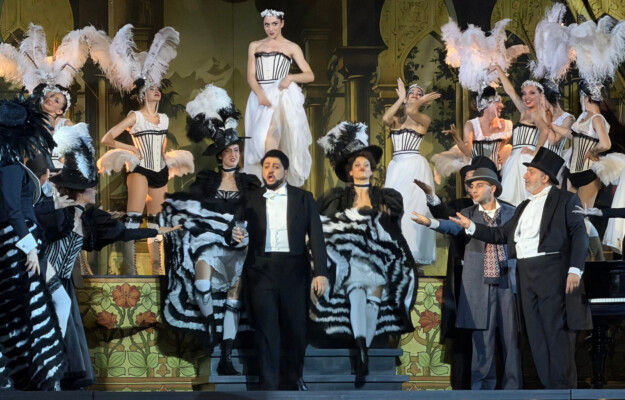
| | | “Libiamo ne’ lieti calici” while dancing the “French Cancan”: it is also a symbolic toast to the beauty of conviviality that makes life sparkling, and it comes about thanks to wine, which unites two countries, Italy and France, where this cultural beverage is part of the national heritage, Giuseppe Verdi’s “La Traviata,” set during the Belle Époque at the Moulin Rouge in Paris, is on the program through September as part of Opera Festival No. 103 at the Arena di Verona, conducted by Michele Spotti and directed by Scottish director Paul Curran (and with WineNews among the 12,000 spectators at the premiere in recent days). | |
|
| | Increasing the percentage of organic matter in the soil to retain more water, creating micro-reservoirs to collect rainwater, managing vine canopies differently, selecting more resilient and high-performing rootstocks, and implementing passive and active protection measures, such as anti-hail nets. These are some of the practical recommendations from the study “The Vineyard and the Changing Climate. Measures to Combat Adverse Climate Conditions for Conegliano Valdobbiadene Prosecco”, presented in Solighetto by the Conegliano Valdobbiadene Prosecco DOCG Consortium and Banca Prealpi SanBiagio. The study is based on climate projections through 2100 provided by researchers from the Meteorology Group at the University of Cantabria.
| |
|
| | When one thinks of the many shades of red, one also thinks of the color associated with the Chianti region, thanks to its signature product, wine, which has helped bring it international fame. Chianti has thus become a chromatic icon of style, a “certified” color that is synonymous with the region. And alongside the traditional reds, the appellation is now enriched by Chianti Rosé DOCG, a new addition championed by the Consorzio Vino Chianti, led by Giovanni Busi, and the result of the new production regulations published in the Official Gazette. | |
|
|
|