If this message is not displayed correctly click here |
Issue 811 - November 9th - 13th 2026 - Expressly created for 3697 wine lovers,
professionals and opinion leaders from all over the world | |
|
|
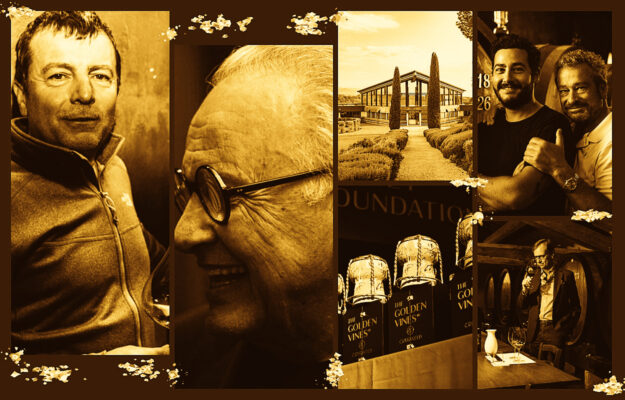
| | | Angelo Gaja in the “Golden Vines Hall of Fame” for his contribution to the industry and the international promotion of Piedmontese wines, while Giacomo Conterno is “Best Fine Wine Producer in Europe”: these are the main accolades for Italy at the 2026 “Golden Vines,” which raised 1.1 million pounds for the Gérard Basset Foundation. Among the highlights of the charity auction, Il Marroneto, owned by Alessandro and Jacopo Mori, a name synonymous with Montalcino, raised £20,000; Biondi-Santi Tenuta Greppo, the “birthplace” of Brunello di Montalcino, now part of the Epi Group, raised £12,500; Ornellaia and Emidio Pepe each received bids totaling £10,500. | |
|
| | Although the wine market has been facing various challenges for some time, land values, at least in the most important appellations and regions, seem to be holding steady, at least at their peak levels. This is according to preliminary findings from the Annual Survey on the Land Market in Italy, conducted by Crea through its Center for Policies and Bioeconomy, with support from Conaf, covering the year 2025. That year, “the market for agricultural land sales will regain momentum, though at varying speeds across the peninsula.” In 2025, average values grew by 0.9%, with a national price nearing 23,000 euros per hectare and a wide regional range: from 48,900 euros in the Northeast to 8,600 euros on the islands. The most valuable land is generally concentrated in the plains, with some exceptions related to specialized production.” Among these are wine-growing lands. At the very top, according to data reported by WineNews, are the vineyards in the Barolo Docg areas “in the lower Langa region of Alba”, where maximum prices are estimated at 2.3 million euros per hectare. Next, in terms of highest price, are the South Tyrolean Doc vineyards in the Lake Caldaro area, at €1,100 per hectare (starting at €600,000, the highest “minimum” value among vineyards), while sharing the third spot on the podium, with a maximum value of €1 million per hectare, are the Bolgheri Doc vineyards (which start at a minimum of €300,000) and the Brunello di Montalcino Docg vineyards (where prices, however, start at €250,000). These plots are also the most highly valued overall in a national “top 10” list spanning various sectors, which also includes the apple orchards of Val Venosta (between €430,000 and €720,000 per hectare) and those of Val d’Adige (between €380,000 and €570,000 per hectare), the vineyards of Valdobbiadene dedicated to Prosecco Docg (between €300,000 and €550,000 per hectare), and also, again in South Tyrol, the Doc vineyards of the lower Val Venosta and the Valle Isarco near Bressanone (in both cases valued between 300,000 and 500,000 euros) and the land used for irrigated horticulture and floriculture in the Piana di Albenga, in Liguria (between 280,000 and 500,000 euros). Among the most valuable vineyards are also those in Trento, Asolo, Chianti Classico, Valtellina, Collio, and beyond. | |
|
| | Italian wine exports remain down compared to last year, but are showing signs of a slow recovery. According to Istat data (which does not include volume figures, ed.), analyzed by WineNews, Italian wine exports from January through August 2026 totaled €4.85 billion in value, down 3% compared to the same period in 2025, an improvement from the 5.3% decline recorded in the first seven months and the 6.2% decline at the mid-year mark. August 2026 alone recorded €506.8 million in exports worldwide, +5.1% over August 2025. In August 2026 alone, compared to August 2025, the U.S. saw a +21.1% increase: €112.1 million in Italian wine imports in August 2026 versus €92.5 million in August 2025. The gap between 2026 and 2025 is narrowing in what remains the No. 1 market for Italian wine: in fact, the value of exports to the U.S. from January through August 2026 rose to 1.1 billion euros. | |
|
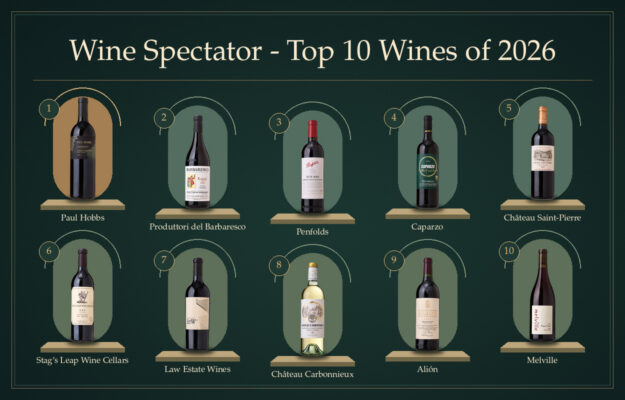
| | | Once again, according to “Wine Spectator,” the world’s No. 1 wine comes from California, and specifically from Napa Valley: it is Paul Hobbs’ 2023 Coombsville Cabernet Sauvignon, the “Wine of the Year” for 2026. This leaves two Italian wines in the “Top” 10 of the world’s most widely followed wine ranking: the 2021 Barbaresco Rabaja Riserva from Produttori del Barbaresco, at No. 2, and Caparzo’s 2021 Brunello di Montalcino, one of the jewels of the region from producer Elisabetta Gnudi Angelini, at No. 4, with the 2024 Bin 389 from Australia’s Penfolds in between at No. 3. The “Top 10” also includes the 2023 Saint-Julien from Château Saint Pierre in Bordeaux, at No. 5, the 2023 Stags Leap District Fay Cabernet Sauvignon from Stag’s Leap Wine Cellars, a California wine excellence founded by the renowned Warren Winiarski and now owned by the Italian Marchesi Antinori (which previously ranked No. 1 on “Wine Spectator’s” “Top 100” list with the 1997 Solaia in 2000), at No. 6, the 2023 Sagacious Adelaida District from Law Estate, also from California; at No. 7, the 2023 Pessac-Léognan White from Château Carbonnieux; at No. 8, the 2022 Ribera del Duero from Bodegas y Viñedos Alion; at No. 9, and the 2024 Pinot Noir Sta. Rita Hills 2024 from Melville, California, at No. 10. The entire 2026 “Top 100” will be revealed on Monday, November 16. | |
|
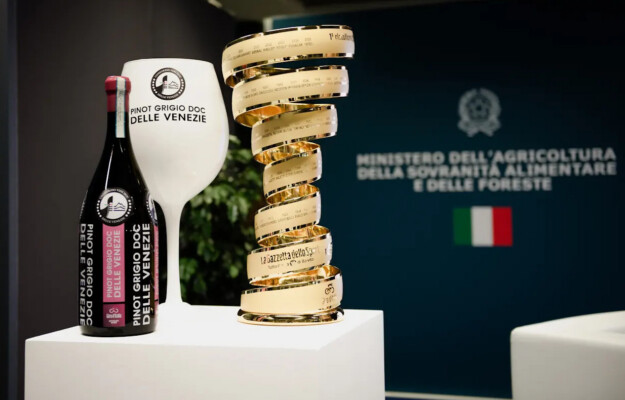
| | | One of Italy’s white wine “gems” will once again toast the successes of the “Corsa Rosa”. In May 2027, Pinot Grigio Doc Delle Venezie will return to the spotlight at the Giro d’Italia, renewing the partnership between the Consorzio Doc Delle Venezie and Rcs Sports & Events. As Luca Rigotti, president of the Consorzio Doc Delle Venezie, explains, “this confirms the Consortium’s commitment to investing in a far-reaching project capable of bringing global visibility to our appellation and showcasing its identity and territorial value”. | |
|
| | Higher than in France, Spain, and Portugal, and yet another confirmation that many tourists captivated by Italy see wine as the “spark” that tips the scales when choosing a destination, demonstrating that wine tourism is an increasingly important resource for the national wine sector. Italy is the country with the highest average spending per booking when comparing four major wine tourism markets: 107 euros, 26% more than France, ahead of Portugal and Spain. And for German-speaking travelers, Italy is first and foremost about food and wine, even before its artistic heritage. This was discussed at the “Salotto Nadia Zenato”, an event dedicated to the prospects of Italian wine tourism and opportunities in international markets. | |
|
| | While awaiting official data on the 2026 harvest, which, according to WineNews rumors, will be released only after the harvest declarations (November 30) or production declarations (by December 15), the “Cantina Italia” bulletin from the Icqrf, based on electronic winery records, continues to indicate a certain surplus of wine in storage. As of October 31, 2026, Italian wineries held 47.7 million hectoliters of wine (+7.2% compared to October 31, 2025), 15.8 million hectoliters of must (+10.6%), and 13.7 million hectoliters of new wine still in fermentation (-4%). | |
|
|
|