If this message is not displayed correctly click here |
Issue 778 - March 23rd - 27th 2026 - Expressly created for 3712 wine lovers,
professionals and opinion leaders from all over the world | |
|
|
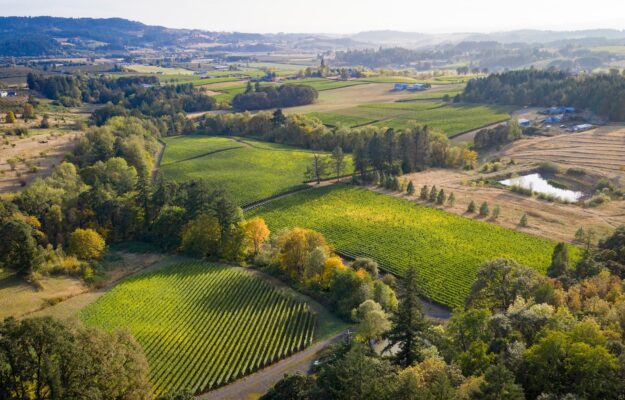
| | | Roco Winery expansion plan goes on, The Oregon-based winery, one of the most awarded and prestigious in the state and wholly owned by Herita USA (the Marzotto family) has acquired the vineyards of Domaine Lumineux. which includes 24 hectares of land, of which 16.6 are cultivated with vineyards. The property was founded by director Francis Ford Coppola in 2019. This is the Marzotto family fourth investment in the Willamette Valley. “This further acquisition reaffirms our belief in the potential of the Willamette Valley and Oregon winemaking more broadly”, explains Andrea Conzonato, CEO of Herita Marzotto Wine Estates.
| |
|
| | Antinori, one of the most prestigious benchmarks in world winemaking and the quintessential history and name of Italian wine (headed by Albiera Antinori together with her father Piero, her sisters Allegra and Alessia, and ceo Renzo Cotarella), is the best European wine brand (and therefore also the best Italian one) worldwide, and ranks No. 2 overall, just behind the most admired brand, which remains that of the Argentine winery Catena. The No. 3 position goes to Familia Torres, the Spanish winemaking institution which completes the podium. This is the verdict of “The World’s Most Admired Wine Brands” 2026, the annual ranking compiled by “Drinks International” magazine and analyzed by WineNews basing on votes cast by an “academy” made up of sommeliers, buyers, wholesalers, Masters of Wine, and wine writers. Italy, as one scrolls through the ranking, is a leading protagonist, with 7 wineries in the “Top 50” and with no “new entries”. At No. 5, there is Gaja, the undisputed symbol of the Langhe of Barbaresco and Barolo, a winery headed by Angelo Gaja. Position No. 16 goes to Ornellaia, one of the jewels of Bolgheri within the Frescobaldi Group, and the wine which climbed 34 positions compared to 2025. Antinori appears again in the ranking with one of its most iconic wines, Tignanello (position No. 21), which made a notable leap of 25 positions compared to the 2025 edition. In the prestigious “list”, there is another brand of absolute excellence from Italy this year: Sassicaia (position No. 30) of Tenuta San Guido, owned by the Incisa della Rocchetta family, which runs the historic Bolgheri estate together with Tenuta San Guido president Alessandro Berlingieri and ceo Carlo Paoli. In position No. 32, there is another top Italian wine brand, Frescobaldi, the historic estate headed by Lamberto Frescobaldi, while at No. 38, there is Planeta, a symbol of Sicilian winemaking which is affirming worldwide. Under the leadership first of Diego Planeta and today of his cousins Alessio, Francesca, and Santi Planeta, the winery is one of the great names of the island winemaking “renaissance”. In a classification which highlights excellence in terms of quality, consistency, innovation, and brand strength, European wine with Italy among the absolute protagonists continues to shine, occupying 36 of the first 50 positions. | |
|
| | A distinctly completely Italian model of aware alcohol consumption, including wine, basing on education about consumption, in close synergy with mealtimes, and clearly different from that of other countries. A model, defined as “The Italian Way” which emerges from the first research study promoted by Federvini and carried out by the Department of Communication and Social Research at La Sapienza University of Rome. The Italian model was presented in recent days in Rome at the event “Responsible Consumption of Alcoholic Beverages: The Italian Way” by Alberto Mattiacci, professor of Economics and Business Management at La Sapienza University and scientific director of the study, and by Fabiola Sfodera, associate professor of Economics and Business Management and chief analyst (in depth). | |
|
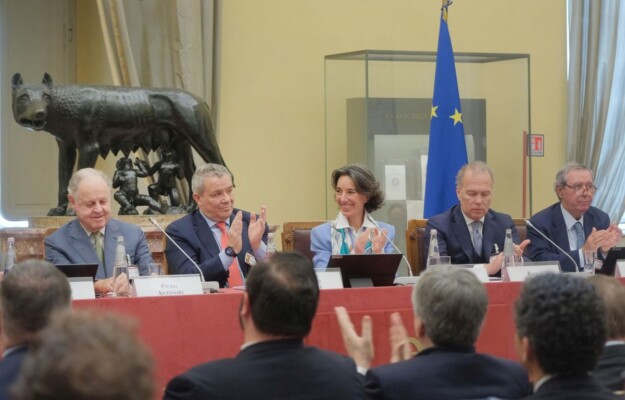
| | | There are those who began their work in wine in 1986, in the year of the methanol scandal; those who had to face it as producers, but also as president of Federvini. A tragic event which nonetheless became the spark for the “renaissance” of Italian wine, thanks to the joint efforts of businesses and institutions. There are those who turned a complex issue such as labor shortages into a real opportunity for economic and cultural integration. There are those who transformed a challenge like excessive heat by inventing night harvesting which also became a powerful communication tool. There are those who helped turn still unknown wines into pillars of Italian wine in the USA and in the world. And there are those who invested, despite extremely high values, in the finest vineyards of Barolo, to achieve excellence. So, there are those who have successfully overcome the many crises which wine faces periodically, and who, even today still look to the future with great optimism despite difficulties. They are the “pioneers” of modern Italian wine, from Piero Antinori (Marchesi Antinori) to Marco Caprai (Arnaldo Caprai), from Josè Rallo (Donnafugata) to Paolo Damilano (Damilano) up to Gaetano Marzotto (Herita Marzotto Wine Estates), who met yesterday in Rome, during the Veronafiere launch of Vinitaly 2026 (Verona, April 12-15).
| |
|
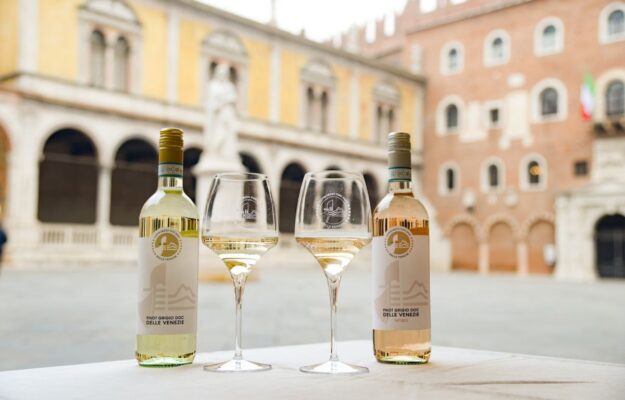
| | | Pinot Grigio Doc Delle Venezie will be the “Official Wine” of Giro d’Italia (May 8-31), 2026. The partnership, which will be presented by Consorzio Doc Delle Venezie on April 13th at Vinitaly 2026, will extend also to Giro d’Italia Women (May 30th-June 7th), Giro-E (May 9-31) and Giro Next Gen (June 14-21). “By sponsoring Giro d’Italia - said the president of the Consortium, Luca Rigotti - we will bring Pinot Grigio DOC Delle Venezie into a narrative which unites sport, territory, community, and lifestyle. This is an important step in clearly affirming the value of the denomination and its leadership in international markets”.
| |
|
| | Relaunching Italian wine beyond the current challenges, with 2025 exports which, after the record of 8.1 billion euros in 2024, slowed down to 7.7 billion euros, nonetheless holding firm, by bringing the world to Verona to explore the quality and diversity of a sector that, between production value (14 billion euros) and its broader supply chain (reaching 45 billion euros), accounts for 1.1% of Italian GDP. This is the mission of Vinitaly 2026, the edition No. 58 in Verona (from April 12th to 15th, at Veronafiere), presented in recent days in Rome (in depth). | |
|
| | The beginning of 2026 was not positive for made in Italy exports. Waiting for the data of April 17th, the Istat note on foreign trade and import prices shows that, whereas overall made in Italy exports recorded a decline of -4.6% in January 2026 compared with the same month in 2025, the agri-food sector fell by -7.7%, a figure particularly weighed down by the sector 26.4% drop in the United States. This data was highlighted by Matteo Zoppas, president of the Italian Trade Agency: “it becomes even more important to strengthen the presence of Italian companies in high-potential markets”.
| |
|
|
|