If this message is not displayed correctly click here |
Issue 781 - April 13th - 17th 2026 - Expressly created for 3711 wine lovers,
professionals and opinion leaders from all over the world | |
|
|
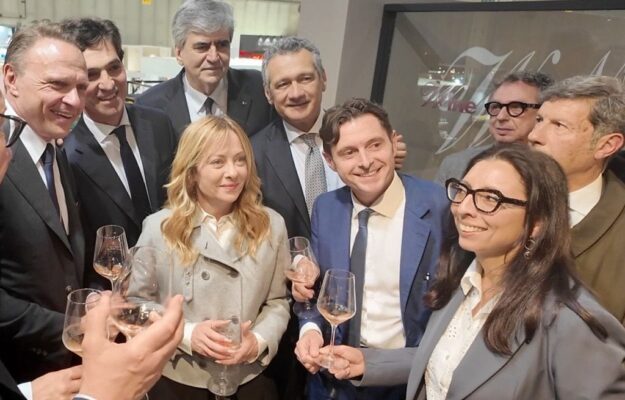
| | | “We are at the most extraordinary showcase of one of the most incredible expressions of our ‘Made in Italy’ products. A sector that continues to bring us enormous satisfaction with its €14 billion annual turnover and which, in a very complex and closely watched general situation, needs to be supported”: these are the words of Prime Minister Giorgia Meloni, on an official visit to Vinitaly 2026 in Verona. “We must make every possible effort to stabilize the situation and reopen the Strait of Hormuz, which is essential for us not only for fuel but also for fertilizers, another fundamental element of the sector”. | |
|
| | A scientific and cultural organization dedicated to public outreach, founded to restore a narrative about wine grounded in scientific evidence, moving away from the oversimplifications that have dominated public discourse in recent years. It is with this premise that the International Academy of Healthy Drinking was founded, promoted by Signorevino - established in 2012 by Sandro Veronesi, one of Italy’s leading entrepreneurs and president of Oniverse (the fashion group with brands such as Calzedonia, Intimissimi, Tezenis, and Falconeri) and Oniwines (which brings together the Tenimenti Leone winery in the Colli Albani region of Lazio, La Giuva in Valpolicella, Podere Guardia Grande in Sardinia, Villa Bucci, a jewel of the Marche region and of Verdicchio dei Castelli di Jesi, the historic Pico Maccario in Monferrato, and Ert1050 in the Trentodoc region), led by Federico Veronesi, ceo Oniwines - with 43 retail locations in Italy and two abroad (Paris and Prague), for a 2025 turnover of 90 million euros - was officially presented at Vinitaly 2026 at Veronafiere in Verona, during the conference “Wine and Longevity. Health, Culture, Conviviality, and Trends”. A board composed of internationally renowned scientists (from Giovanni Scapagnini to Karin Michels, from Arrigo Francesco Giuseppe Cicero to Paolo Francalacci, Eugenio Luigi Iorio, Andrea Sbarbati, Giovambattista Desideri, Immaculata De Vivo, Donald Craig Willcox, and Davide Grassi) with the goal of studying longevity to address the public debate on the relationship between wine and health with scientific rigor: a discussion that is often oversimplified, ignoring the biological and cultural complexity of the Mediterranean lifestyle. An attempt, therefore, by the wine world to respond to the criticism it faces, following a demonization that, moreover, the distinction from alcohol in general, as explained by Giovanni Scapagnini, Professor of Clinical Nutrition at the University of Molise, one of Italy’s leading experts in nutritional geroscience and founder of the Committee, who opened the proceedings by drawing a distinction that the most recent literature increasingly supports: wine is not equivalent to alcohol in a generic sense and occupies a scientifically distinct position relative to it, citing two recently published studies in support. | |
|
| | An Italian wine sector that is aware of the challenges of the current period, yet also looks to the many opportunities emerging around the world, recognizing that certain measures to curb production will need to be considered, but that growth is still possible, thanks in part to the joint efforts of businesses and institutions, led by the Ministry of Agriculture and ICE, by promoting even more effectively and with a CMO decree better suited to the needs of businesses, or by continuing to invest, including in international markets, in the institutional campaign supporting Italian wine culture launched by the Ministry, which reached over 71 million contacts in its first phase. These messages emerged (in greater detail) from the “Wine Roundtable” convened by the Minister of Agriculture, Francesco Lollobrigida, at Vinitaly 2026 in Verona. | |
|
| | | Vines and wine embody a universal cultural and historical value that extends far beyond the wine itself and the economy, however substantial, that it generates. And so, just as Italian cuisine was recognized as a UNESCO World Heritage, thanks to the way we experience the table and the conviviality that revolves around it, of which wine is a central element, in the same way the seeds are being sown to garner broad institutional and international support for a possible nomination of the culture of vines and wine as a UNESCO World Heritage, under the ideal umbrella of the International Organisation of Vine and Wine (OIV), which today brings together 51 producing countries from around the world, to further protect and promote a crop, the vine, and a product, wine, that have accompanied a large part of humanity for millennia. And which is under pressure now more than ever, amid climate change, markets that are turbulent to say the least, and profound shifts in consumption patterns and attitudes toward “drinking and health”. This message comes from Vinitaly 2026 in Verona, on the day of the official visit to Veronafiere by the European Union Commissioner for Agriculture, Christophe Hansen, and OIV Director General John Barker, alongside Minister of Agriculture Francesco Lollobrigida, and others (read more). | |
|
| | | Revenue from wine tourism for Italian wineries totals €3.1 billion, a figure that accounts for 21% of the average contribution to total revenue. This data emerges from Vinitaly 2026 in a new report by Nomisma. In 2025, compared to 2024, 47% of wineries saw an increase in the number of wine tourists visiting, and 50% reported higher revenue from wine tourism, figures that are projected to grow by 48% and 51%, respectively, over the next 12–18 months, confirming a positive outlook. | |
|
| | With production finally launching in Italy after years of legislative gridlock, the country’s No-Lo wine producers - who until now had been manufacturing abroad - discussed the potential of Italian-made dealcoholized wines at Vinitaly 2026, drawing on data from the Uiv-Vinitaly Observatory. Sales value in large-scale retail in Germany, the UK, and the US stands at 1.2 billion euros for 160 million bottles: figures set to grow in markets where Italian No-Lo wines - currently at 2.5% - must play the quality and “Made in Italy” cards to bridge the time gap, according to stakeholders. By 2026, Italian production is expected to increase by 90%, with exports accounting for 91% and the bulk of sales occurring in retail (77%). For the industry’s major players (read more) the success of Italian No-Lo wines hinges on the “Made in Italy” label and, in the future, on the grape varieties listed on the label.
| |
|
| | A “white pearl” of wine meets the “Pink Race” in a partnership between sports and wine poised to write a new and significant chapter in the history of these two Italian icons. At Vinitaly 2026, at the Ministry of Agriculture, the partnership between the Consorzio DOC Delle Venezie and RCS MediaGroup for the Giro d’Italia was unveiled, with a toast featuring Pinot Grigio Delle Venezie, Italy’s top-exported still white wine, which will be the “Official Wine” of the 109th Giro d’Italia in 2026 (May 8–31), one of the major races in international cycling.
| |
|
|
|