If this message is not displayed correctly click here |
Issue 798 - August 10th - 14th 2026 - Expressly created for 3689 wine lovers,
professionals and opinion leaders from all over the world | |
|
|
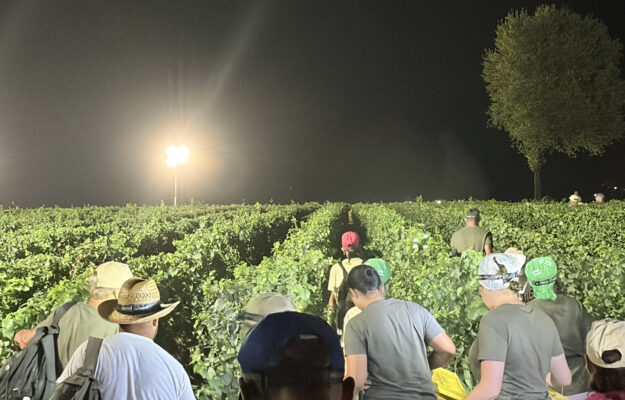
| | | The 2026 Italian grape harvest is taking shape, with many areas experiencing one of the earliest harvests on record, though the situation varies from north to south. And while in Sicily, Franciacorta, and Oltrepò Pavese, harvesting has already been underway for days, grapes have also begun to be picked in Alta Langa, with “very positive” expectations according to the Piedmont Metodo Classico sparkling wine consortium, and in the Euganean Hills, where the grapes are in excellent condition. Harvesting is also underway in the Tuscan Maremma, a couple of weeks earlier than usual, with a very positive outlook on quality, explains the Consortium’s president, Francesco Mazzei. | |
|
| | After months of significant recovery, albeit within a negative overall context, the trend in Italian wine exports appears to be “stabilizing” in May 2026, at least in terms of value. However, performance in key markets, from the United States to Germany and the United Kingdom, has worsened compared to April 2026. This is according to Istat data analyzed by WineNews: from January to May 2026, Italian wine exports totaled nearly 3 billion euros (2.98 billion euros), down 6.86% compared to the same period in 2025, a percentage change that, in fact, is consistent with the trend observed in April 2026. In terms of export volumes, the total was 809.1 million liters, representing a 5% decline compared to the first five months of 2025, a figure that is also worse than the 3.7% decline recorded in April 2026. The United States, the top market for Italian wine, imported 709 million euros’ worth of wine, and the comparison with 2025 remains significantly negative (-15.4%) and in line with the figures recorded in the first four months of 2026, even though volumes have fallen significantly compared to the last report, slipping to -6% compared to 2025, for a total of 141.5 million liters. Germany remains the No. 1 market in Europe and the No. 2 market worldwide for Italian wine, with exports totaling 439.1 million euros (-8.2% compared to 2025) and volumes down 9.3% (180 million liters). Exports to the United Kingdom also declined to 278.5 million euros (-6.5%), with volumes down 6.6% (88.5 million liters) when comparing the first five months of 2025 to those of 2026. Canada, at 159.5 million euros, remained stable compared to the same period in 2025. Following are Switzerland at 143.8 million euros (-12.7%) and France at 127.1 million euros (-2.9%). The Dutch market is worth 97.9 million euros (-6.6%), while the Belgian market saw a double-digit decline to 79.2 million euros (-12.6%). Sweden follows at 78.4 million euros (-2.4%) and Russia at 71.9 million euros (+17.4%). As for the Asian market, Japan remained stable (-0.2%) at 99.7 million euros; China, on the other hand, posted an excellent percentage increase, reaching 34.1 million euros, up 18% from 2025, despite starting from a lower baseline. Among the pleasant surprises is the emerging market of Brazil at 16.9 million euros (+15.2%), while there is no good news from Australia, where exports totaled 23.4 million euros (-16.9%). | |
|
| | Brazil, one of the emerging wine markets, is accelerating its imports. According to Secex Brasil data analyzed by OIV, wine imports into Brazil in the first half of 2026 reached 79.4 million liters (+9.1%), with a value of 234.3 million euros (+5.9%), compared to the first half of 2025. Chile remains the leading exporter (+9.7%) at nearly 93 million euros. Argentina ranks second at 39.9 million euros (+1.7%), and Portugal ranks third at 36.5 million euros (+11.8%). France ranks fourth at 27.5 million euros (-0.8%), ahead of Italy (fifth), which made a significant leap forward compared to the first half of 2025 (+7.2%, an increase of 1.3 million euros) to 19.7 million euros, but wine exports to Brazil are also growing in volume, reaching 4.8 million liters (+2.2%): here, Italy ranks third, ahead of Spain and France. | |
|
| | | From a “no” to a general plan for grubbing up vineyards to rebalance supply and demand, to a “yes” where necessary, but with a “Plan B” to protect farmers: this marks a change of course and an openness to a controversial measure, namely the funding of vineyard grubbing-up (already widely adopted in France and other wine-producing countries, ed.), as expressed by Lamberto Frescobaldi, president of Unione Italiana Vini (UIV) and producer at the helm of the Frescobaldi Group. Until now, in a debate that remains wide open within the industry regarding which measures to adopt to reduce wine production that, in part, cannot find a market (as of July 31, there were still 42.6 million hectoliters of wine in Italian cellars, up 6.9% from July 31, 2025, according to “Cantina Italia” data by ICQRF), has focused primarily on reducing yields for generic wines (difficult to implement and unsustainable in certain areas that, according to many, also rely on volume, ed.), as well as on halting authorizations for new vineyards (which, however, even in this case, if applied across the board, would penalize appellations and producers who, even during this general phase of contraction, are still managing to grow, ed.). Meanwhile, there is now also this new approach to vine removal “subject to certain conditions” (see in-depth analysis). | |
|
| | | Sandra Misale, 41, born in Calabria, heads a laboratory bearing her name at Johns Hopkins University in Baltimore. If patients with pancreatic or colon cancer, among others, can now hope for a more effective treatment, they owe it in part to her. And on September 19, in Montalcino, she will be presented with the “Casato Prime Donne Award” by Donatella Cinelli Colombini’s all-female winery, “Casato Prime Donne”. In the journalism category, the winners are Francesca Ciancio (a freelance writer and contributor to WineNews) and Andrea Cuomo (“Il Giornale”). | |
|
| | Premium fine wines continue to show signs of a recovery, particularly when looking at the last 12 months and the indices of Liv-Ex, the leading platform for the secondary market and wine collecting. The indices analyzed by WineNews include the Liv-Ex 100, which showed an increase of +0.4% in the first 7 months of 2026, though this should be viewed in the context of a much stronger +3.3% gain over the course of the entire year. The Liv-Ex 1000 was in line with the trend in 2026 (+0.3%), but lagged behind over the 12-month period (+1.2%). The Italy 100 stood out, posting a +1.5% gain since the start of 2026 and a +2.9% gain over the 12-month period. The Italy 100’s resilience, explains Liv-Ex, “was driven by the index’s Tuscan components.” The 9 most traded Tuscan wines by value in 2026 are Sassicaia, Tignanello, Ornellaia, Masseto, Guado al Tasso, Biondi-Santi’s Brunello di Montalcino, Solaia, Fuligni’s Brunello di Montalcino, and Soldera Case Basse’s 100% Sangiovese Toscana IGT. | |
|
| | From Pasqua Vigneti e Cantine to Marilisa Allegrini, from Tommasi Family Estates to Allegrini, from Romano Dal Forno to Ottella, and the newcomer Santi, among the “Benefactors”; and from Masi Agricola to Vittorio Moretti, among the “Leaders”: these are the Italian wine entrepreneurs who, to date, “support” the “67 Columns for the Verona Arena,” one of the most important patronage projects featuring a fundraising campaign promoted by the Fondazione Arena, which raised over 2 million euros in 2025 for one of Italy’s most prestigious cultural institutions. | |
|
|
|