If this message is not displayed correctly click here |
Issue 764 - December 15th - 19th 2025 - Expressly created for 3696 wine lovers,
professionals and opinion leaders from all over the world | |
|
|
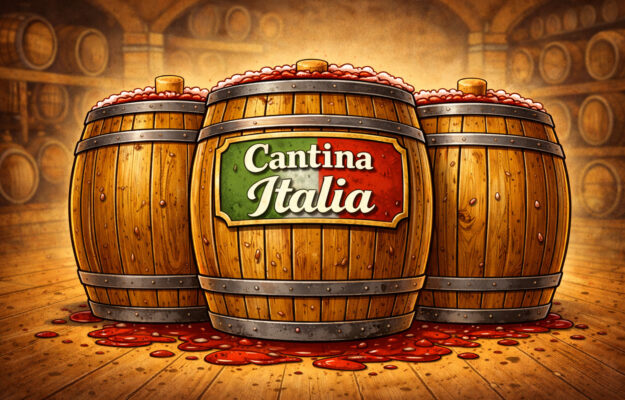
| | | Finding yourself with almost 10% more wine in your cellar than last year, while consumption is falling, is not exactly ideal. Yet this is the situation in Italian wineries, according to the November 30, 2025 update of “Cantina Italia” compiled by the ICQRF, which reports that there are 53.4 million hectoliters in stock, 8.6% more than on the same date in 2024, to which must be added 9.5 million hectoliters of new wine still fermenting and 9.7 million hectoliters of must. | |
|
| | Italian wine exports worldwide are slowing down again, as shown by Istat data, analyzed by WineNews and updated to September 2025, which, compared to the first nine months of 2024, give a negative verdict: -2.2% in value (from -1.9% in August), to €5.7 billion, recovering, however, in volume, while remaining in negative territory (-0.9% compared to -2.9% in August), to 1.5 billion liters, demonstrating how prices are falling. Compared to September 2024, the figure for the same month in 2025 is -9.6% at €659.5 million. As always, the most significant factor is the “score” of the United States, the leading trading partner for Italian wine, at €133.2 million in September 2025 compared to €153.1 million in September 2024: -13% month-on-month (but better than the -30.1% recorded in August 2025 compared to August 2024) for a total export value of €1.35 billion over the nine months (-4.1% compared to the same period in 2024).In terms of volume, from January to September 2025, the United States totaled 256.8 million liters (-2.29%), a figure that remained stable compared to the last survey. Germany, the world’s second largest importer of Italian wine and the largest in Europe, offers positive news: a market worth €843.1 million for Italy (+2.1%). The United Kingdom brings more negative news with €587.6 million in value (-2.3%); there was a sharp slowdown in Canada, which until August had been one of the positive surprises of 2025 for Italian wine, but in the “Land of Maple” the +11.3% recorded up to August 2025 (on an annual basis compared to 2025) fell to -5.25% in September, to €318.1 million. Switzerland also fell to €275.4 million (-4.2%), in contrast to France, which, with €235.5 million (+4.4%), continued to increase its purchases, as did the Netherlands with €185.5 million (+8.6%). Therefore, Italian wine continues to face difficulties in international markets. While the overall figures for August have worsened, sounding yet another alarm bell, the volume figures, which are recovering, reveal that prices are falling in response to what appears to be weaker demand. All this with a bumper 2025 harvest for Italian wine, with stocks increasing in the cellars in contrast to consumption (in more detail). | |
|
| | In the Mediterranean, wine has always been an element of conviviality: drinking consciously and with meals has marked the moment of “eating together,” of bonds, exchanges, and belonging. But also for mental health, a prospective analysis shows that moderate and regular consumption was associated with a lower incidence of depression compared to abstinence, while high consumption reversed the trend, increasing the risk. This is explained in the research by Professor Giovanni Scapagnini of the University of Molise, promoted by Signorvino, which shows how wine consumption is linked to its Mediterranean context: small quantities, with meals, in company, in a diet rich in vegetables, legumes, whole grains, and olive oil, supported by an active lifestyle. With the glass as a “social condiment” and wine as a bridge between well-being and culture.
| |
|
| | | Without a doubt, Michelin’s debut in “wine critics”, with the awarding of “grapes”, or rather “Michelin Grapes” to wineries (and not to individual wines, which will remain, for now, the focus of “The Wine Advocate”, also owned by Michelin, and which, at least in the immediate future, will continue on its current path), with a rating from 1 to 3 “grapes”, as announced in early December, will have a significant impact, given the group’s communicative power and the widely (but not unanimously, at least among experts, ed.) recognized authority of the “Red Guide”. But while some things are already clear, others, as is natural in any new project, are much more nuanced and less defined. For example, Michelin itself has announced that the first wine selections will cover areas such as Bordeaux and Burgundy, so it is easy to guess that Champagne will soon follow in France, and then it will probably be Italy’s turn, given the prestige of the wines from the two regions, starting with Piedmont and Tuscany (but, according to the usual rumors, Veneto or Sicily could also be included, ed.). These are the most salient aspects that emerge from Michelin’s responses to the questions that WineNews asked the French guide (in depth). | |
|
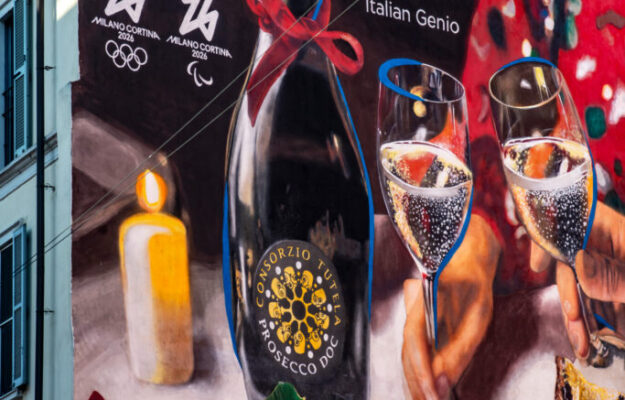
| | | Among the most eclectic, but also the most direct and popular contemporary forms of expression, wine also entrusts its messages to street art. This is the case of the Prosecco Doc Consortium, which unveiled a new mural in Milan (in Viale Pasubio 6) for the holidays, signed by Italian street artist Mate, towards Milan Cortina 2026, of which it is the “Official Sparkling Wine” for the event, to celebrate the city and its excellence, but also a symbolic combination that recounts the tradition of Italian dining between Christmas and New Year’s Eve, its sharing and conviviality. | |
|
| | “The launch of an institutional campaign is a necessary step: not only to defend the sector, but also to restore a mature and identity-based view of the country’s heritage”. This is the message from the “Wine Supply Chain Round Table” held in Rome in recent days - with Alleanza Cooperative Agroalimentari, Assoenologi, Cia-Agricoltori Italiani, Coldiretti, Confagricoltura, Copagri, Federdoc, Federvini, Fivi, and Unione Italiana Vini (Uiv) - which “expressed widespread and general appreciation for the continuous and constant attention shown by the government (as evidenced by the presence of Prime Minister Giorgia Meloni at the first meeting on August 5, in the photo, ed.) in a 2025 that has seen the Italian wine sector face complex moments”. | |
|
| | An award dedicated to artists who have made exceptional contributions to music and wine: the first edition of the “Beethoven Friendship Award” goes to the composer Tan Dun, who receive the “cup of friendship” and a cabinet containing 12 magnums. The award is supported by Michele De Lucchi and 11 prestigious wineries: Gaja, Tenuta San Guido, Domaine Paul Jaboulet, Aïne, Klaus Peter Keller, Château Lascombes, Domaine Jacques-Frédéric Mugnier, Erwin Sabathi, Schloss Gobelsburg, Château Smith Haut Lafitte, Weingüter Wegeler, Vega Sicilia, and Château D’Yquem. | |
|
|
|