If this message is not displayed correctly click here |
Issue Issue 762 - December 1st - 5th 2025 - Expressly created for 3705 wine lovers,
professionals and opinion leaders from all over the world | |
|
|
| | | Christmas 2025 will also be remembered for the transition of the Advent Calendar from a niche phenomenon to a widespread trend, with brands selling the excitement of opening a box a day until December 24, containing everything from chocolate to wine, tea to mini-spirits. WineNews also wanted to get in on the act, offering its own Advent Calendar, published day by day on Instagram. Every day, a story featuring a bottle of Italian wine, not chosen from the usual rankings, but selected by our followers: the 24 labels in the Calendar are those most clicked on in 2025 by the more than 55,000 followers of @WineNewsIt. | |
|
| | Tenute Piccini, Mezzacorona, Frescobaldi, Villa Sandi, Marchesi Antinori, Cavit, Zonin1821, La Marca, Cantine Riunite & Civ (part of Gruppo Italiano Vini - Giv) and Terre Cevico: these are the 10 best wineries in the digital world, based on an overall assessment of parameters such as social media channels, e-commerce, languages used, digitization, and more, according to the 12th edition of the “Il gusto digitale del vino” (The Digital Taste of Wine) 2025 research by Omnicom Pr Group Italia, carried out on a small but significant sample, given that it examines the digital strategies of the top 25 Italian wineries by turnover (according to Mediobanca data, ed.). Special awards were also presented: Antinori received the “Social Media” award for the best social media strategy, Herita Marzotto Wine Estates received the “Climate & Sustainability” award for being the first Italian winery to obtain “Carbon Neutral” certification for its commitment to sustainability and biodiversity, and to Tenute Piccini for “Education & Social” for its investment and commitment to educational and social projects that promote wine culture and strengthen ties with the community and the environment. In a nutshell, the research (complete in depth) explains that, for the third consecutive year, LinkedIn is confirmed as the social network with the most significant growth in terms of new followers for wineries (+29%) and is also the most popular platform together with Instagram and Facebook, which remains the social network with the largest fanbase, with around 1.3 million users. 40% of wineries have revamped and invested in their web properties (website or content) to improve the user experience. According to Massimo Moriconi, General Manager and CEO of Omnicom Pr Group Italia “in the immediate future, one of the opportunities to be seized by the sector is linked to the optimization of digital assets for new search engines based on artificial intelligence (Generative Search Optimization), which provide assertive responses capable of creating initial perceptions of the behavior of the brand and its products. In this sense, it will be crucial to create qualified media visibility and focus on the consistency of information”. | |
|
| | More than French Champagne and Spanish Cava, Prosecco is the sparkling wine that has grown the most in recent years, in percentage terms, in value and volume, confirming itself as not only an Italian but also an international phenomenon. A snapshot of the sparkling wine market, dominated by Italy, France, and Spain, comes from figures analyzed by Del Ray Analysts of Wine Markets. Sparkling wine remains the wine with the highest average price per liter (€7.83), even though it is the only type to have recorded a decrease in the last 12 months (-1%). France, Italy, and Spain account for 85% of total global sales and 75% of sparkling wine volume. The boom in Prosecco, which accounts for 75% of Italian bottled sparkling wine, is evident. Sales growth in Italy, driven by Prosecco, has been much more consistent than that of its competitors. | |
|
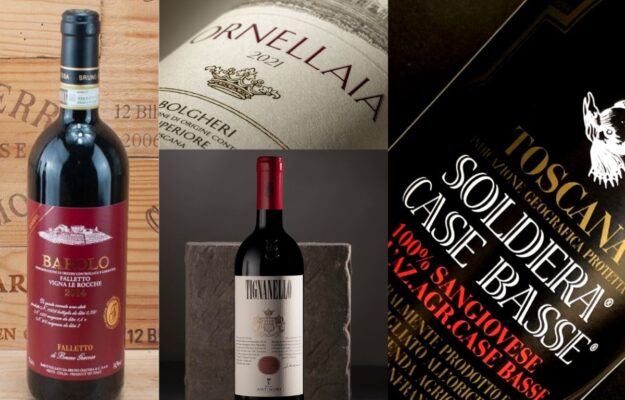
| | | The positive signs on the secondary market for fine wines, monitored by the Liv-Ex platform, which is somewhat of a barometer for the performance of the world’s great collectible wines, are small but steady, and therefore encouraging. After many consecutive months of decline, the November 2025 data consolidates the small reversal in trend recorded since last September. Looking at the indices, the Liv-Ex 100 is up 0.9% month-on-month, further reducing the negative figure since the beginning of the year to -2.8%. The broader Liv-Ex 1000 index gained another +0.4% month-on-month, reducing its loss since the beginning of 2025 to -4.5%. The Italy 100 index remained essentially unchanged, posting -0.1% month-on-month and -1.8% since the beginning of the year. Looking at the best-performing individual wines since the beginning of the year, the best Italian wines in the Liv-Ex 100, and the only two in the top 10, are Ornellaia 2021, the Frescobaldi Group’s Bolgheri gem, and Tignanello 2020, one of Antinori’s flagship wines. In the broader Liv-Ex 1000, the absolute best of all 1,000 wines in the index is Bruno Giacosa’s Barolo Falletto Vigna Le Rocche Riserva, up 59.7% since the beginning of the year, accompanied in the “Top 10” by Soldera Case Basse’s 100% Sangiovese 2018, up 23.7%. | |
|
| | | From the “city of lovers”, capital of Valpolicella, to which it has been linked since the 16th century, to the “pearl of the Dolomites”: from December 30, Verona’s Antica Bottega del Vino, a “temple” of Italian wine and one of the attractions of one of Italy's most visited cities of art, opens in Cortina d’Ampezzo, a timeless winter tourism destination in Italy, in the spotlight as never before thanks to the upcoming Milan-Cortina 2026 Winter Olympics (starting February 6). A project and a challenge desired by the Famiglie Storiche, the owners, and director Luca Nicolis. | |
|
| | The rumor was in the air, and now it has been confirmed, coming directly from France, of course: after restaurants, with their “stars” or rather “macarons”, and hotels, with their “keys”, the Michelin Guide will now also have a symbol for wine. Or rather, for wineries, given that companies and producers will be rated with a score of 1 to 3 “grapes” or “Michelin Grapes”. The “grapes” will be awarded according to five well-defined criteria: “agronomic quality”, “technical mastery”, “identity”, “balance”, and “consistency” (in-depth explanation). This, therefore, will be the “Wine Selection” by the Michelin Guide which, obviously, starting in 2026, will begin in its “mother country”, France, with Bordeaux and Burgundy. But it goes without saying that coverage will soon extend to the most prestigious wine regions in the world, with Italy at the forefront. | |
|
| | Better balancing supply and demand, strengthening climate adaptation, simplifying and harmonizing labeling practices, encouraging promotion and innovation, increasing the flexibility of facilities, and stimulating rural economies through wine tourism. Furthermore, strengthening the sector’s ability to respond to changing consumer preferences and seize opportunities from emerging markets. These are the cornerstones of the long-awaited “Wine Package”, with the Council and the European Parliament reaching a provisional agreement (in more details). | |
|
|
|