If this message is not displayed correctly click here |
Issue 773 - February 16th - 20th 2026 - Expressly created for 3684 wine lovers,
professionals and opinion leaders from all over the world | |
|
|
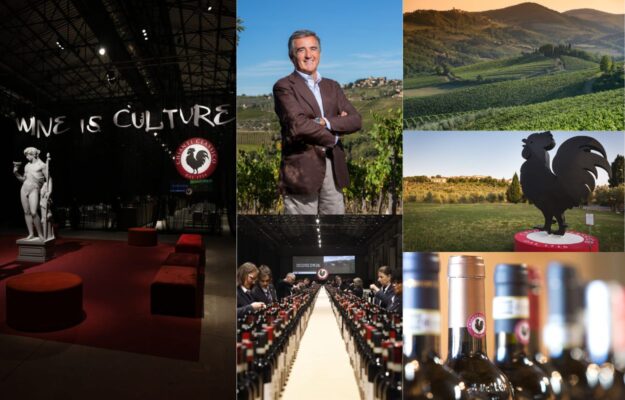
| | | Singing louder than the many crises inside and outside the world of wine, the Black Rooster of Chianti Classico, with its wine growing in volume (+1.2%) and value (+2.6%) in 2025 despite everything, promotes the concept that “wine is culture”, which was the leitmotif of the “Chianti Classico Collection 2026”, also working towards UNESCO recognition for “the landscape of the Chianti Classico villa-farm system”. It is one of the most beautiful and unspoiled areas in the world, and it is thanks to its wine that it keeps its culture, landscape, and social fabric alive. | |
|
| | Italian wine exports continue to decline, widening the gap with 2024 figures, a year which, it should not be forgotten, set a historic record for wine exports from Italy (€8.1 billion). According to Istat data, analyzed by WineNews and updated in November 2025, compared to the first 11 months of 2024, the “score” shows a decline of 3.58% in value (compared to -2.7% in October) to €7.2 billion and -2% in volume (compared to -1.4% in the previous month) to 1.95 billion liters. The performance of the United States, a historic and irreplaceable trading partner for Italian wine, continues to weigh heavily: -8% in value at €1.62 billion and -5.7% in volume at 312.2 million liters. In October 2025, compared to the same period in 2024, the United States recorded -5.6% in value and -3.2% in volume, demonstrating a negative November for Italian wine shipments, where tariffs and the euro-dollar exchange rate clearly have a significant impact. Germany remains the leading European partner for Italian wine in terms of value and the number one overall in terms of volume. However, looking at the figures, although still positive, there was a slight decline compared to October: +0.8% to €1 billion, while volumes fell by 3.1% to 442.6 million liters. Completing the podium is the United Kingdom, which continues to see a decline in purchases: -4.2% in value to €770.1 million and -2.4% in volume to 240.7 million liters. In fourth place is Canada, which, after a promising start to the year, fueled by a slowdown in purchases of American wines, is gradually reducing its imports: in November 2025, compared to the same period in 2024, we are at €384.6 million (-6.9%). Overall, Italian wine exports are not sinking, but continue to navigate through uncertainty and difficulties. November 2025 once again painted a negative picture and, with very few exceptions, the trends did not offer any promising signs of change. The data for the United States is striking: excluding August, it is the worst in terms of value for the whole of 2025, and it is difficult to imagine that there will be a turnaround in December. Meanwhile, the wine world is looking ahead to 2026, which has started with high stocks in the cellars and many challenges to face in a complex scenario. | |
|
| | Italy plays a “poker” hand at The Institute of Masters of Wine, with the first Italian woman to achieve this goal. That is Cristina Mercuri, “the first Italian woman to obtain one of the most selective titles in the international wine scene”. Her name joins those of the other three Italian Masters of Wine to date, namely Andrea Lonardi, Gabriele Gorelli, and Pietro Russo. Cristina Mercuri earned her title with a final thesis on “Wine, Women and Fascism: A Visual Analysis of the Representation of Women in Propaganda in Enotria (1922-1942)”, a study of the illustrated covers of Enotria, Italy’s first magazine specializing in wine. This theme goes hand in hand with one of the aspects of her professional commitment, as she promotes scholarship programs and training courses with the aim of making the sector more inclusive and meritocratic. | |
|
| | | Four centuries after the birth of Francesco Redi (1626-1697), who already defined it as “the king of all wines”, Vino Nobile di Montepulciano continues its virtuous journey in the history of Italian wine, adding its role as a landscape and economic cornerstone to a territory rich in history, as emerged during the two-day “Anteprima del Vino Nobile” event. Italy’s first DOCG (of which the first label of its kind is preserved), it is centered on a production area strictly limited to the part of the municipality of Montepulciano between 250 and 600 meters above sea level, and boasts 1,400 hectares of vineyards registered in the appellation register, for a total production of over 6,377,000 bottles in 2025. With 82 bottling companies in the Consorzio del Vino Nobile (representing over 90% of the vineyard area), a turnover of €65 million, and a total asset value of €1 billion. With a positive market outlook for 2025, despite the unfavorable scenario, and a 2023 harvest in the glass (see our best tastings for more details) rated 4.5 stars, which gives confidence to a territory that, as emerged from the Santa Chiara Lab research, is at the forefront in terms of the multifunctionality of companies and sustainability. | |
|
| | | The prestigious Salento winery Leone de Castris, which has made history in Italian rosé wines, has joined the French association “Les Hénokiens”, an exclusive club (57 companies from all sectors, from all over the world) that requires its members to have at least two centuries of company history, uninterrupted ownership by the same family, and proven financial stability. In addition to De Castris, Guerrieri Rizzardi, a Venetian winery founded in 1678, also represents Italian wine in Les Hénokiens. | |
|
| | Overall Italian wine bottling in 2025 down 2.1% on 2024, but positive for DOCG and DOC, the driving forces behind wine exports, up 1% both on an annual basis and on the average for the last three years. IGT wines, on the other hand, are down, recording a significant contraction of -12% compared to 2024 and -10% compared to the average of the previous three years, while, in general, there are mixed performances among the different types of wine: sparkling wines performed well (+1%, with Prosecco DOC reaching, according to Istat data, 1.6 billion in value from January to November 2025, -1.7% compared to -3.6% for Italy as a whole), rosés (+5.7%) and still whites (+2.7%), while reds fell by more than -13%. Valoritalia, the main certification body for the wine industry, speaks of a “substantial stability in volum”, which are higher than pre-Covid levels. | |
|
| | The positive impact that wine can have on territories and communities, as a driver of development and social inclusion, with fair work in the vineyard and responsible agricultural choices, looking to the future of young people who struggle to access land and that of mountain territories that can be revitalized, but also to women whose role in the world of wine is becoming increasingly fundamental. This will be discussed at the 2026 “Slow Wine Fair” (February 22-24), an event dedicated to “good, clean and fair wines” according to Slow Wine. | |
|
|
|